What is maintenance software for building technology?
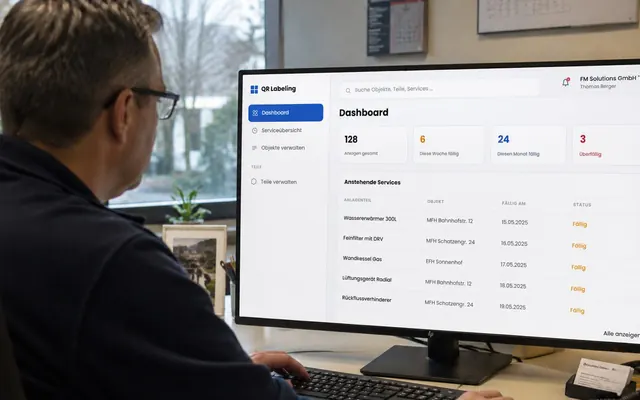
Maintenance software for building technology keeps all of a building's components that require maintenance in one place: water heaters, heat pumps, ventilation units, water softeners and pumps. It records maintenance intervals, service history and documents, and reports when a service is due. QR Labeling is exactly this kind of maintenance software: components are recorded by photo, and the maintenance plan is created from them.
How does QR Labeling create a maintenance plan automatically?
Every component recorded by photo comes with its own maintenance interval, suggested according to the manufacturer's specifications. From all components of an object, a maintenance plan with concrete dates builds up continuously, without anyone having to maintain a planning file. If an interval changes, the date moves with it. Maintenance planning therefore keeps running in the background, even when nobody in the company is thinking about it.
How does AI component capture work?
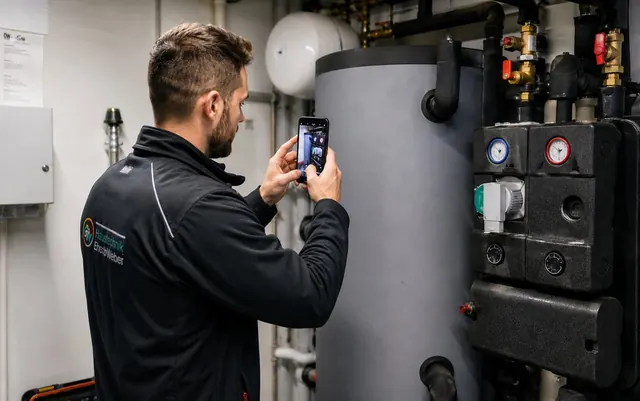
Photograph the component or its nameplate, and the AI recognises the component type, manufacturer, model, serial number and year of manufacture and stores the data on the component. All details are visible and can be corrected before saving. The QR code is then created and attached to the component. Recognition also works in poor light and at an angle.
Can installer, operator and property management work together?
Yes. The installer shares the systems they have installed and maintained with the operator and property management at the touch of a button; all three see the same equipment inventory, the same service history and the same deadlines. Property management thereby receives proof that the system has been maintained. Each party keeps its own view, and duplicate lists become unnecessary.
Do we need specialist knowledge or training?
No. QR Labeling runs in the browser on phone, tablet and computer; no installation is required. Anyone who can take a photo can record components. The first component is usually recorded within five minutes of signing up. On site in the plant room, a phone is all you need, and the follow-up office work is eliminated.
What does QR Labeling cost?
QR Labeling costs CHF 59 per month for one user, CHF 39 per user per month from two users, and from nine users by arrangement. Anyone who only views shared components, tracks services or opens documents pays nothing. The digital revision folder costs a one-off CHF 289 including the first year of hosting, thereafter CHF 49 per year for hosting and support.
We currently manage our systems in Excel. How do we switch?
No data migration is needed. You photograph the components on site, and the AI reads manufacturer, model, serial number and year of manufacture from the nameplate. This is usually faster than cleaning up an Excel list that has grown over the years, and the details match what is actually installed in the plant room. You can start with a single object.
How long does implementation take and who records the existing systems?
There is no implementation project. Your own people record the inventory piece by piece, usually during a service visit that is due anyway. You do not need to record the whole portfolio before the first benefit appears: as soon as an object is recorded, its maintenance plan is in place. Many companies start with one property and add the others afterwards.
Can we manage several properties separately?
Yes. The equipment inventory is structured by objects and, within an object, by trades such as heating, sanitary, electrical and ventilation. Property management therefore sees each property on its own, and a building services contractor sees each customer on its own. Sharing is per object, so an operator only sees the systems that concern them.
As property managers, how do we prove that maintenance was carried out?
Every service job is logged on the component and remains permanently visible there, with the date and the company that carried it out. The QR code on the component leads directly to this service history. Towards the owner, the insurer or a new service partner, it can thus be demonstrated when each system was maintained, without searching through folders or email threads.
How do planners and building owners obtain the contractors' revision documents?
Through the tender. If the item for the cross-trade revision folder is put out to tender, the contractors deliver their revision documents to info@qr-labeling.ch. From these, the digital revision folder is created and installed in the central plant room as a panel with a QR code. The tender is a more effective moment for this than chasing documents after acceptance.
What does maintenance according to Swiss standards mean?
The terms are used differently. SIA 469 from 1997 uses "Erhaltung" (preservation) as the umbrella term and groups monitoring, upkeep, repair, renewal and modification beneath it. The European SN EN 13306, by contrast, covers the whole spectrum under maintenance. The KBOB therefore recommends defining the terms explicitly within the project. QR Labeling maps the activities regardless of what they are called.
Where is our data stored?
The data is stored in a data centre in Stuttgart, Germany, and therefore within the EU. It is not passed on to third parties and not analysed for any other purposes. The data processing agreement is publicly available on this website, and we will name the operator of the data centre on request.
Does it work in a plant room without signal?
Yes. That is exactly what the QR code on the component is for. In the basement you photograph the code and the component, even without signal. As soon as you have a connection again, in the stairwell, in the car or in the office, you assign the photos to the component and log the service work. There is no need to go back to the plant room.